The Ultimate Guide to Designing Heated High-Visibility Clothing for Night-Shift Workers
Introduction
Night‑shift workers require apparel that simultaneously provides illumination, thermal comfort, and regulatory compliance. This guide outlines the essential concepts, design strategies, and product recommendations that enable manufacturers and designers to meet those needs. Readers will learn about material science, heating element integration, safety standards, and how to select appropriate commercial products. By the end of the article, one will possess a comprehensive roadmap for creating effective heated high‑visibility garments.
Background and Context
High‑visibility clothing (HV) originated in the early twentieth century to reduce occupational accidents in low‑light environments. Modern HV garments incorporate reflective fabrics that return light to its source, thereby increasing wearer conspicuity. Heating technology, once limited to industrial gloves, now extends to full‑body apparel through flexible resistive elements and battery packs. Understanding the interaction between reflectivity, insulation, and active heating is critical for designing safe night‑shift solutions.
Regulatory bodies such as the American National Standards Institute (ANSI) and the International Safety Equipment Association (ISEA) define performance classes that dictate minimum retro‑reflective area and luminance. Class 2 garments, for example, are suitable for low‑speed traffic and construction sites, while Class 3 garments target high‑speed vehicular environments. In addition to visibility, flame‑resistance (FR) and moisture‑wicking properties are often mandated by industry‑specific regulations.
Design Principles for Heated High‑Visibility Clothing
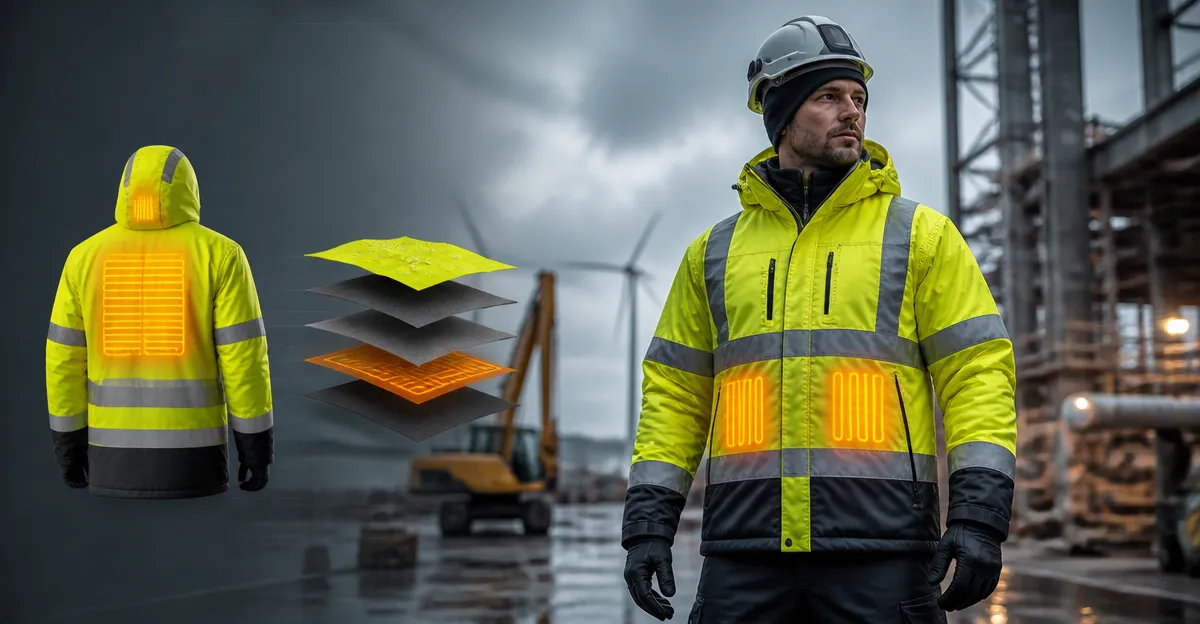
Effective design begins with a clear definition of the target work environment, including ambient temperature range, exposure duration, and required visibility class. The garment must balance thermal insulation with breathability to avoid heat stress during periods of physical exertion. Heating elements should be placed strategically—typically along the torso, back, and sleeves—where core temperature loss is greatest.
Power management is another cornerstone; designers must select battery packs that deliver sufficient wattage while remaining lightweight and safely sealed. Integration of a temperature control module allows the wearer to adjust heat output, reducing the risk of overheating. All electronic components must be sealed against moisture and dust to meet IP (Ingress Protection) ratings appropriate for outdoor work.
Material Selection and Insulation
Base fabrics for HV clothing are commonly polyester or nylon blends that support retro‑reflective tape adhesion. For heated garments, a secondary insulating layer such as fleece, Thinsulate®, or a thermal‑lined polyester is added to trap warm air without restricting movement. The insulation must be compatible with the heating element, allowing conductive pathways while preventing short circuits.
Moisture‑wicking liners are recommended to transport sweat away from the skin, thereby maintaining thermal comfort and preventing skin irritation. When flame‑resistance is required, fabrics such as FR‑treated cotton or specialized blends should be used, as they retain visibility while meeting fire safety standards. The final outer shell should incorporate at least two-inch wide reflective strips that meet ANSI Class 2 or Class 3 specifications.
Integrating Heating Elements
Resistive heating wires, carbon‑fiber panels, or printed polymer heaters are the most common technologies for apparel integration. These elements are typically sewn into channels or laminated between fabric layers to protect them from mechanical stress. The heating zones are connected to a central controller that monitors temperature and battery voltage.
Designers must ensure that heating zones do not interfere with reflective tape placement; overlapping reflective material with heating elements can diminish visibility. Conductive threads can be used to route power discreetly along seams, preserving the garment’s aesthetic and functional integrity. Safety cut‑offs should be programmed to disengage power if the temperature exceeds a pre‑set threshold, thereby protecting the wearer.
Safety Standards and Compliance
Compliance with ANSI/ISEA 107‑2021 is non‑negotiable for any HV garment sold in the United States. The standard outlines minimum retro‑reflective area, color coding, and performance testing procedures. For heated garments, additional certifications such as UL‑2050 for battery safety and IEC 62133 for rechargeable cells are advisable.
When flame‑resistance is required, the garment must also meet NFPA 2112 or EN ISO 11612, depending on the jurisdiction. Testing laboratories evaluate flame‑spread, heat‑release, and after‑flame time to verify compliance. Documentation of all test results should be retained for regulatory audits and customer assurance.
Product Recommendations
Below are several commercially available items that illustrate best‑practice features for heated high‑visibility apparel. Each product has been selected for its alignment with the design principles discussed above.
- JKSafety Hi‑Vis Safety Vest – This Class 2 vest offers two spacious pockets, a front zipper, and ANSI‑compliant reflective bands. Priced at $13.99, it holds a 4.7‑star rating from 135 reviews, indicating reliable durability for daily use. The vest’s lightweight polyester construction makes it an ideal base layer for adding heating inserts.
- Y4WG High‑Visibility Safety Vest – Featuring four 2‑inch reflective bands, breathable mesh panels, and multiple utility pockets, this vest scores 4.9 stars from 40 reviewers. At $14.99, it provides ample ventilation, which is advantageous when integrating active heating to prevent excess moisture buildup.
- Carhartt HV Thermal Sweatshirt – This Class 3 sweatshirt incorporates midweight fleece, a thermal lining, and 3M™ Scotchlite™ reflective material. With a price of $104.99 and a 4.6‑star rating from 520 reviews, it serves as a premium insulated shell that can accommodate embedded heating panels without sacrificing flexibility.
- NOZUONO Reflective Heat Transfer Vinyl – This 2‑inch by 5‑yard fluorescent yellow‑striped tape can be ironed onto garments to augment visibility in custom designs. Priced at $15.99 and rated 3.9 stars by 118 reviewers, it is useful for retro‑fitting existing apparel with additional reflective zones.
- BOCOMAL FR High‑Visibility Shirt – Combining flame‑resistant fabric with reflective strips, this shirt meets both safety and visibility requirements. At $51.28 with a 4.7‑star rating from 978 reviews, it illustrates how FR performance can be integrated without compromising reflectivity.
Comparison and Selection Guide
When choosing a base garment for heating integration, consider the following criteria: visibility class, insulation thickness, pocket configuration, and material compatibility with heating elements. Table 1 summarizes the key attributes of the five products highlighted above.
| Product | Visibility Class | Insulation | Heat‑Ready Features | Price |
|---|---|---|---|---|
| JKSafety Hi‑Vis Safety Vest | Class 2 | None (polyester) | Spacious pockets for battery packs | $13.99 |
| Y4WG High‑Visibility Safety Vest | Class 2 | Mesh breathable | Multiple utility pockets, ventilation | $14.99 |
| Carhartt HV Thermal Sweatshirt | Class 3 | Midweight fleece | Loose cut for heating panels | $104.99 |
| NOZUONO Reflective Heat Transfer Vinyl | Supplementary | None (adhesive) | Custom reflective zones | $15.99 |
| BOCOMAL FR High‑Visibility Shirt | Class 2 | FR‑treated | Integrated reflective tape | $51.28 |
For workers in extremely cold climates, the Carhartt sweatshirt provides the most robust thermal base, while the JKSafety and Y4WG vests are cost‑effective options for layering with separate heating inserts. The NOZUONO vinyl is valuable for retro‑fitting any garment with additional high‑visibility strips, and the BOCOMAL shirt demonstrates how flame‑resistance can coexist with visibility.
Best Practices & Tips
- Conduct a risk assessment to determine the required visibility class and thermal protection level for each job site.
- Select fabrics that are both reflective and compatible with the chosen heating technology; avoid materials that melt at low temperatures.
- Place heating elements away from reflective tape to prevent visual obstruction and maintain compliance with ANSI standards.
- Use modular battery packs that can be detached for laundering; ensure connectors are sealed with waterproof grommets.
- Implement a user‑friendly temperature control interface, preferably with a low‑power Bluetooth or NFC option for remote monitoring.
- Perform field testing under real‑world conditions, measuring both temperature distribution and conspicuity distance.
- Document all component certifications and retain test reports for regulatory review.
Frequently Asked Questions
1. Does adding heating elements affect the garment’s ANSI visibility rating?
No. Visibility rating is determined by the size, placement, and retro‑reflective performance of the reflective material. Heating elements must be positioned so they do not cover or diminish the reflective zones.
2. Can the heating system be washed with the garment?
Most heating components are not machine‑washable. Designers should provide removable battery packs and sealed heating panels that can be detached before laundering.
3. What battery capacity is required for an eight‑hour night shift?
Typical low‑voltage heating panels consume 5‑10 W. A 10 Ah lithium‑ion pack at 12 V can sustain 8 hours of operation, but designers should calculate based on specific wattage and include a safety margin.
4. Are there any health concerns with prolonged exposure to heated garments?
When temperature control is properly regulated, the risk of burns or heat stress is minimal. Users should be educated to monitor skin temperature and to discontinue use if discomfort occurs.
5. How does flame‑resistance interact with heating elements?
FR fabrics are designed to self‑extinguish; however, heating elements must be rated for use with FR materials to avoid compromising flame‑resistance. Selecting heating wires with a high melting point and low arc resistance mitigates this risk.
Conclusion
Designing heated high‑visibility clothing for night‑shift workers demands a multidisciplinary approach that blends material science, electrical engineering, and regulatory knowledge. By following the principles outlined in this guide, manufacturers can create garments that keep workers visible, warm, and protected from occupational hazards. The product examples provided illustrate how existing market offerings can serve as foundations for more advanced, integrated solutions.
Products Featured in This Guide
JKSafety Hi‑Vis Safety Vest
Price: $13.99 | Rating: 4.7/5 (135 reviews)
Featured because it provides an affordable, ANSI‑Class 2 base layer with ample pocket space for heating batteries.
Y4WG High‑Visibility Safety Vest
Price: $14.99 | Rating: 4.9/5 (40 reviews)
Featured for its breathable mesh construction and extensive pocket layout, which facilitate integration of heating modules.
Carhartt HV Thermal Sweatshirt
Price: $104.99 | Rating: 4.6/5 (520 reviews)
Featured as a premium insulated shell that meets Class 3 visibility and can accommodate larger heating panels.
NOZUONO Reflective Heat Transfer Vinyl
Price: $15.99 | Rating: 3.9/5 (118 reviews)
Featured for its ability to add custom reflective strips to any garment, enhancing visibility without altering the base design.
BOCOMAL FR High‑Visibility Shirt
Price: $51.28 | Rating: 4.7/5 (978 reviews)
Featured because it demonstrates how flame‑resistant fabric can be combined with reflective elements, a requirement for many high‑risk occupations.