Best Battery for Heated Clothing: Complete Guide to Choosing the Right Power Bank (mAh, Voltage & Runtime)
Introduction
Heated clothing has become an essential accessory for outdoor enthusiasts, commuters, and anyone who faces cold environments for extended periods. Selecting the appropriate power source is as critical as choosing the garment itself, because the battery determines comfort, safety, and overall usability. This guide explains the fundamental concepts of capacity, voltage, and runtime, and it provides actionable advice for matching a power bank to a specific heated garment. Readers will also discover two vetted products that exemplify the principles discussed, allowing them to make an informed purchase decision.
Background and Context
Modern heated apparel integrates thin heating elements that draw power from a portable battery, typically via a USB or DC connector. The heating elements operate at either 5 V (standard USB) or 7.4 V (higher‑power configurations), and the battery must supply a stable voltage within that range to avoid damage. Lithium‑polymer (Li‑Po) cells dominate this market because they combine high energy density with a lightweight form factor, which is essential for garments that must remain comfortable on the body.
Consumers often encounter marketing terms such as "mAh" (milliampere‑hours) and "conversion rate" without a clear understanding of their practical implications. A higher mAh rating indicates a larger stored energy reservoir, but the actual runtime also depends on the voltage and the garment's heat setting. Moreover, safety features such as over‑voltage protection, short‑circuit detection, and automatic sleep modes extend the lifespan of both the battery and the heated garment.
Key Concepts: Capacity, Voltage, and Runtime
Capacity (mAh) measures the total charge a battery can store. For heated clothing, a 10 000 mAh pack typically provides 3–10 hours of heat, depending on the temperature setting, while a 20 000 mAh pack can double that duration. However, capacity alone does not guarantee longer runtime; the efficiency of the power conversion circuitry also plays a vital role.
Voltage determines compatibility with the heating element. Most vests and jackets use 5 V, which aligns with standard USB outputs, whereas many full‑body jackets require 7.4 V DC. Using a battery with the wrong voltage can cause insufficient heating or, in worst cases, irreversible damage to the heating wires.
Runtime is the practical measure of how long a garment stays warm before the battery is depleted. It is calculated by dividing the usable capacity (adjusted for conversion efficiency) by the power draw of the heating element at a given setting. Manufacturers often provide approximate runtimes for high, medium, and low heat modes, which serve as useful benchmarks for comparison.
Choosing the Right Voltage for Your Garment
Before purchasing a power bank, verify the voltage requirement printed on the garment’s label or user manual. If the label specifies 5 V, a standard USB power bank will suffice; however, if it indicates 7.4 V, you must select a unit that includes a dedicated DC output port. Some batteries, such as the MRBIU 20000mAh Heated Jacket Power Bank, provide both 5 V USB and 7.4 V DC outputs, offering flexibility for multiple garments.
When a garment supports both voltages, consider the heat intensity you plan to use most frequently. High‑heat settings draw more current, which can reduce overall runtime, whereas low‑heat settings conserve power and extend usage time. Selecting a battery with a higher conversion efficiency (often advertised as a percentage improvement over previous models) will mitigate this effect.
Understanding Runtime Expectations
Runtime estimates are typically presented as ranges for high, medium, and low heat settings. For example, a 10 000 mAh pack may deliver 3 hours on high heat, 6 hours on medium, and 10 hours on low. A 20 000 mAh pack generally doubles those figures, providing 4–10 hours on high heat and up to 10 hours on low, depending on the garment’s power draw.
Real‑world factors such as ambient temperature, wind chill, and the wearer’s activity level also influence runtime. Physical activity generates body heat, which can reduce the power required to maintain comfort, while extremely low temperatures increase the heating element’s demand. Therefore, it is prudent to choose a battery with a capacity margin of at least 20 % above the manufacturer’s stated requirement.
Product Recommendations
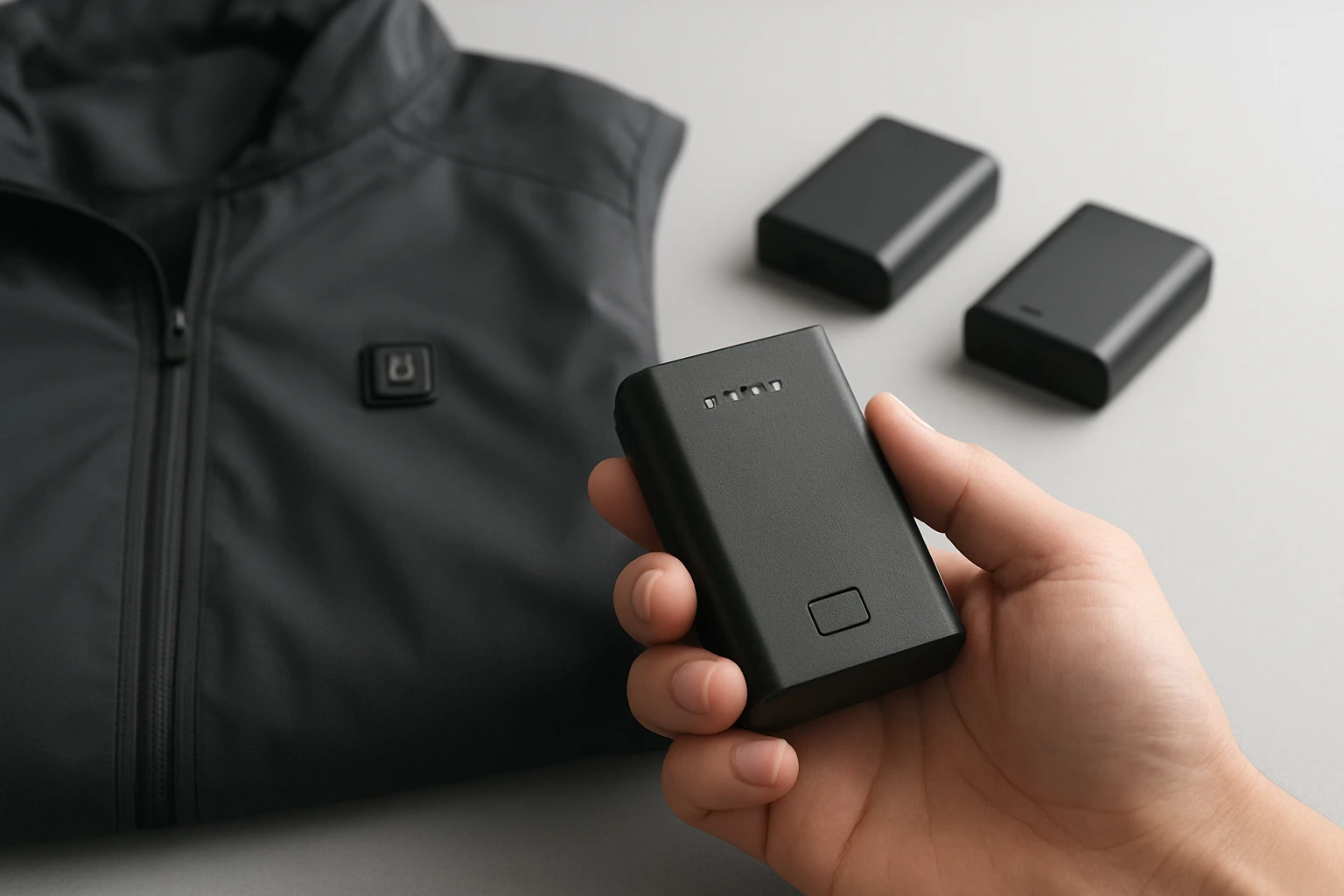
Two power banks stand out for their blend of capacity, voltage flexibility, and safety features. The first, Whsahans 10000mAh Heated Vest Power Bank, is optimized for 5 V garments and includes intelligent auto‑start and sleep functions that conserve energy when the vest is not in use. Its compact size matches the dimensions of a typical smartphone, making it unobtrusive when worn under a jacket.
Key specifications of the Whsahans model include:
- Capacity: 10 000 mAh
- Output: 5 V / 2 A (no DC port)
- Safety: Over‑voltage, over‑current, over‑charge, and short‑circuit protection
- Runtime: 3 hours (high), 6 hours (medium), 10 hours (low)
- Rating: 4.4/5 from 1,714 reviews
The second recommendation, MRBIU 20000mAh Heated Jacket Power Bank, offers dual voltage outputs (5 V USB and 7.4 V DC) and an LCD display that shows remaining charge with 1 % granularity. Its larger capacity is ideal for full‑body jackets or scenarios where extended outdoor exposure is expected.
Key specifications of the MRBIU model include:
- Capacity: 20 000 mAh
- Outputs: 5 V / 2 A USB, 7.4 V DC (compatible with 3.5 mm, 3.8 mm, 4.0 mm plugs)
- LCD display: 1 %–100 % battery level
- Runtime: 4–6 hours (high), 6–8 hours (medium), 8–10 hours (low)
- Rating: 3.9/5 from 43 reviews
Comparison and Selection Guide
| Feature | Whsahans 10 000 mAh | MRBIU 20 000 mAh |
|---|---|---|
| Voltage Compatibility | 5 V only (no DC) | 5 V USB & 7.4 V DC |
| Capacity | 10 000 mAh | 20 000 mAh |
| Runtime (Low Heat) | ≈10 hours | ≈10 hours (larger garment) |
| Safety Features | Over‑voltage, over‑current, over‑charge, short‑circuit protection | Same protections + UL & CE certifications |
| Display | None (auto‑start/sleep) | LCD percentage display |
| Price | $21.98 | $14.99 |
| User Rating | 4.4/5 (1,714 reviews) | 3.9/5 (43 reviews) |
When deciding between these models, consider the following decision matrix:
- If your heated apparel requires only 5 V and you value a lightweight, pocket‑sized design, the Whsahans unit is the logical choice.
- If you own a jacket that demands 7.4 V or you anticipate needing longer runtime for multi‑day trips, the MRBIU model provides the necessary voltage flexibility and double the capacity.
- If visual feedback of remaining charge is important for planning outings, the MRBIU’s LCD display offers a clear advantage.
- Budget constraints may favor the Whsahans model, though the MRBIU’s lower price point combined with higher capacity often yields better overall value.
Best Practices & Tips
- Always verify the voltage requirement of your garment before connecting a power bank; mismatched voltage can cause overheating or device failure.
- Charge the power bank with a wall adapter that meets the recommended input (typically 5 V / 2 A) to ensure a full charge in the shortest time.
- Utilize the auto‑sleep feature present in many modern power banks to conserve energy when the garment is not actively heating.
- Store the battery at room temperature when not in use; extreme cold can temporarily reduce capacity, while extreme heat can degrade cell health.
- Periodically inspect connectors for wear or damage, especially on models with detachable DC plugs, to maintain reliable power delivery.
Frequently Asked Questions
- What is the difference between 5 V and 7.4 V power banks?
- 5 V units are designed for garments that use standard USB heating elements, while 7.4 V units supply higher voltage required by larger jackets and full‑body systems. Using the wrong voltage can reduce heating efficiency or damage the heating wires.
- How many charges can I expect for my smartphone from these batteries?
- The Whsahans 10 000 mAh pack can recharge an iPhone 13 approximately 2–3 times, whereas the MRBIU 20 000 mAh pack can provide roughly 4–5 full charges, assuming typical usage patterns.
- Is it safe to leave the power bank attached to the garment overnight?
- Both models incorporate over‑charge and short‑circuit protection, and they automatically enter sleep mode when the heating element is idle. Nevertheless, it is advisable to disconnect the battery once the garment has cooled to prolong battery lifespan.
- Can I use these power banks for other devices like power banks or LED lights?
- Yes. Both units feature standard USB outputs that can charge smartphones, tablets, or LED accessories. The MRBIU model also includes a Type‑C port for additional versatility.
- What should I do if the charging port becomes loose?
- If the port shows signs of looseness, discontinue use immediately and contact the seller for a replacement under warranty. Continuous use of a compromised port can lead to intermittent power delivery and potential safety hazards.
Conclusion
Choosing the right battery for heated clothing hinges on understanding capacity, voltage, and runtime, as well as matching those parameters to the specific garment you intend to use. The Whsahans 10 000 mAh power bank excels for lightweight 5 V vests, offering compactness and reliable safety features. The MRBIU 20 000 mAh model provides dual‑voltage output, a clear LCD display, and a larger energy reserve, making it ideal for full‑body jackets and longer excursions. By applying the decision framework and best‑practice tips outlined in this guide, readers can confidently select a power bank that maximizes warmth, safety, and convenience.
Products Featured in This Guide
Whsahans 10000mAh Heated Vest Power Bank
Price: $21.98
Rating: 4.4/5 (1,714 reviews)
Featured because it delivers a compact 5 V solution with intelligent auto‑start/sleep features, making it ideal for lightweight heated vests.
MRBIU 20000mAh Heated Jacket Power Bank
Price: $14.99
Rating: 3.9/5 (43 reviews)
Featured because it provides dual‑voltage output, a high‑capacity 20 000 mAh battery, and an LCD display, suitable for full‑body jackets and extended outdoor use.