Introduction
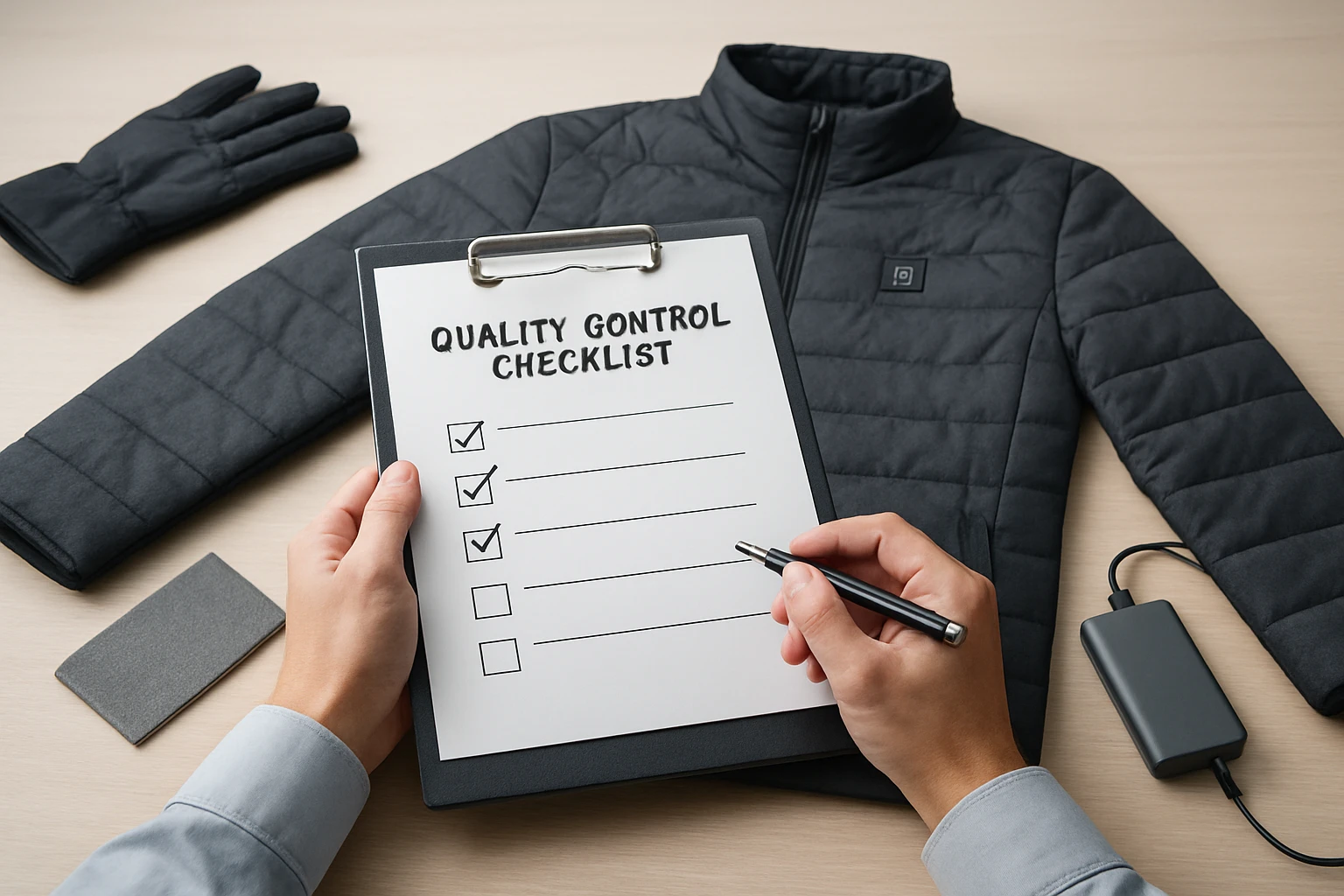
This guide provides a comprehensive quality control checklist for manufacturers of heated clothing. Readers will learn how to design, test, and certify heated garments to meet safety and performance expectations. The article balances theoretical standards with practical product examples that illustrate best practices. By following this checklist, manufacturers can reduce warranty claims, improve customer satisfaction, and ensure regulatory compliance.
Background and Context
Heated apparel integrates electrical heating elements, power sources, and textile engineering. The market has expanded rapidly as consumers seek comfort in cold climates without bulky layers. However, the combination of electricity and fabric introduces unique hazards such as short circuits, overheating, and battery failure. Understanding material science, electrical engineering, and regulatory frameworks is essential for producing reliable products.
Design and Material Standards
Manufacturers must select fabrics that provide water resistance, durability, and breathability. A common choice is 20D nylon, which offers lightweight protection while allowing heat to escape when necessary. The garment should incorporate insulated pockets and reinforced stitching at stress points to prevent tearing during active use. Compliance with ISO 15512 for textile safety and ASTM F2992 for heated apparel is recommended.
For example, the Venustas Heated Jacket uses 20D nylon fabric and includes a detachable hood, six heat zones, and three temperature settings. The jacket has earned a rating of 4.4 out of 5 stars from 2,233 reviews, indicating strong consumer acceptance. Its water‑resistant construction demonstrates adherence to material standards discussed above. Manufacturers can model their fabric selection after this product to achieve similar performance.
Electrical Safety Testing
All heating elements must be tested for insulation resistance, continuity, and temperature uniformity. Test procedures should follow IEC 60335‑2‑40, which outlines requirements for electrically heated clothing. Each heating zone should be verified to stay within the specified temperature range of 30 °C to 45 °C on the low, medium, and high settings. Over‑temperature protection circuits must be validated to shut off power when thresholds are exceeded.
In addition to built‑in safety features, external power sources require rigorous evaluation. The RUIPU Battery Pack provides 7.4 V output with a 30,000 mAh capacity, supporting both DC and USB ports. It holds a 4‑star rating from 84 reviewers, reflecting reliable performance in real‑world scenarios. Testing this battery pack for short‑circuit protection and charge‑cycle durability can inform manufacturers about robust power‑management solutions.
Battery Performance and Longevity
Battery packs must deliver consistent power for the advertised duration, typically eight hours for mid‑range garments. Cycle‑life testing should simulate daily charge‑and‑discharge cycles for at least 500 iterations to assess capacity retention. Manufacturers should also evaluate charging time, ensuring that a full charge can be achieved within a reasonable period, such as three to four hours.
The RUIPU Battery Pack advertises a charge time of a few hours and a runtime of up to eight hours, matching industry expectations. Its 7.4 V output is compatible with many heated jackets, including the Venustas Heated Jacket, which utilizes a detachable battery pack. By integrating a battery with proven cycle‑life data, manufacturers can reduce field failures and improve warranty outcomes.
User Interface and Control Reliability
Control modules must be intuitive, durable, and resistant to moisture ingress. Buttons or touch panels should be rated for at least IPX4 protection, allowing operation under light rain. The control system should provide clear feedback through LEDs or a small display indicating temperature level and battery status.
The Venustas Heated Jacket features a single‑button interface that cycles through three temperature settings and a power indicator. Customer feedback highlights occasional connection issues between the battery and jacket, emphasizing the need for robust connector design. Manufacturers should consider reinforced connectors and strain‑relief mechanisms to mitigate such problems.
Compliance with International Regulations
Heated clothing sold in the United States must comply with FCC Part 15 for electromagnetic emissions, while European markets require CE marking under the Low Voltage Directive. In addition, the garment must meet the Consumer Product Safety Improvement Act (CPSIA) for lead and phthalate content. Documentation of test results and a technical file should be maintained for each product batch.
Both featured products are listed as “In Stock” on Amazon, implying that the sellers have met the basic regulatory requirements for the marketplace. However, manufacturers should conduct independent verification rather than relying solely on marketplace listings. Maintaining a compliance checklist that references each applicable standard streamlines the certification process.
Comparison and Selection Guide
When selecting components for heated apparel, manufacturers must weigh factors such as power capacity, weight, and user comfort. The Venustas Heated Jacket offers an integrated solution with a detachable battery, making it suitable for consumers who prefer an all‑in‑one garment. Its price point of $119.98 positions it in the mid‑range market.
Conversely, the RUIPU Battery Pack is a standalone power source priced at $27.06, offering flexibility for retrofitting existing jackets or powering multiple devices. Its high capacity of 30,000 mAh enables extended use across several garments. Manufacturers should choose the integrated jacket for streamlined product lines, or the separate battery pack for modular designs that allow end‑users to upgrade power capacity independently.
Best Practices and Tips
- Implement a Design for Testability (DfT) approach, ensuring that heating elements and connectors are accessible for inspection.
- Conduct accelerated aging tests by exposing garments to temperature cycles of –20 °C to 60 °C for 200 hours to reveal potential material fatigue.
- Document every test result in a centralized quality management system to facilitate traceability.
- Provide clear user manuals that describe proper charging, storage, and maintenance procedures to reduce misuse.
- Offer a warranty period of at least one year, covering battery defects and heating element failures, to build consumer trust.
Frequently Asked Questions
- What is the typical warranty period for heated jackets? Most manufacturers offer a one‑year warranty covering battery and heating element defects, although premium brands may extend coverage to two years.
- How can I test for overheating in a prototype? Use infrared thermography to monitor surface temperature while the garment operates at maximum setting for at least 30 minutes. Verify that temperatures do not exceed the manufacturer’s specified limit.
- Are there specific certifications required for battery packs? Yes, battery packs must comply with UN 38.3 for transport safety and UL 2054 for household and commercial use.
- Can heated clothing be washed? Garments should be machine‑washable only after removing the battery pack. Follow the manufacturer’s instructions regarding water‑resistant closures and drying methods.
- What are the most common causes of heating element failure? Poor solder joints, inadequate insulation, and mechanical stress on flexible circuits are frequent failure points.
- Is it safe to use heated clothing while driving? Yes, provided the garment does not interfere with seatbelt operation and the battery pack is securely stored to prevent movement.
- How does IP rating affect product design? An IPX4 rating ensures protection against splashing water, which is essential for outdoor use in rain or snow.
Conclusion
This checklist equips heated clothing manufacturers with the knowledge to design safe, reliable, and compliant products. By adhering to material standards, performing rigorous electrical testing, and selecting appropriate power solutions, manufacturers can minimize defects and enhance brand reputation. The inclusion of real‑world product examples demonstrates how theoretical guidelines translate into market‑ready solutions. Implementing the best practices outlined herein will position manufacturers for long‑term success in the growing heated apparel market.
Products Featured in This Guide
Venustas Heated Jacket
Price: $119.98
Rating: 4.4 out of 5 stars (2,233 reviews)
Featured because it exemplifies an integrated heated garment with water‑resistant nylon fabric, six heat zones, and a detachable 7.4 V battery that lasts up to eight hours.
RUIPU Battery Pack
Price: $27.06
Rating: 4 out of 5 stars (84 reviews)
Featured because it provides a high‑capacity 30,000 mAh 7.4 V power source with DC and USB outputs, suitable for powering heated jackets and other wearable electronics.