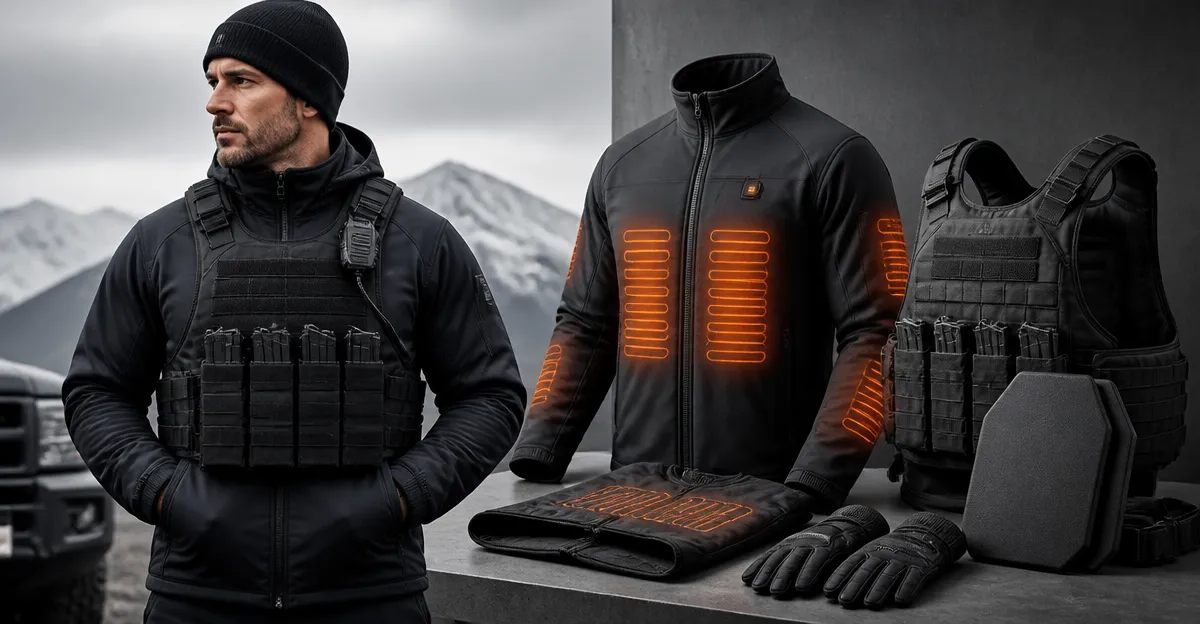
Heated Clothing and Body Armor: A Practical Guide to Compatibility, Safety & Top Picks
Introduction
The modern operative, outdoor enthusiast, or winter worker often faces the dual challenge of staying warm while maintaining mobility and protection. This guide explains how heated garments interact with body armor, outlines safety considerations, and presents the most highly rated heated apparel currently available on the market. Readers will learn the underlying technology, how to match heating elements with protective gear, and which products deliver reliable performance in demanding environments.
While heated clothing can dramatically improve comfort, improper use may compromise safety or reduce the effectiveness of body armor. The following sections provide a balanced view that integrates scientific principles with real‑world product examples.
Background and Context
Heated clothing relies on electrically powered elements—usually carbon fiber or metal alloy strips—embedded in strategic zones of a garment. When powered by a battery pack, these elements raise the temperature of the surrounding fabric, creating a microclimate that reduces the perceived cold. The most common power source is a USB‑compatible power bank, which offers flexibility but also introduces considerations regarding weight, battery life, and water resistance.
Body armor, whether soft ballistic panels or hard plates, is designed to distribute impact forces while remaining breathable. Adding a heated layer beneath armor can improve comfort, but the additional thickness may affect fit and heat dissipation. Understanding the thermal conductivity of armor materials and the placement of heating zones is essential for safe integration.
Key Concepts and Product Recommendations
Heated apparel can be categorized by design intent, heating zone distribution, and power management. The following subsections discuss each category and recommend a product that exemplifies the concept.
1. Full‑Body Core Heating Vests
Core heating vests concentrate warmth around the torso, back, and abdomen—areas most vulnerable to cold stress. The DR.PREPARE Heated Hooded Vest provides three temperature settings (High 131°F, Medium 122°F, Low 113°F) and six carbon fiber elements that cover the neck, back, abdomen, and waist. At a price of $54.99 and a rating of 4.1 stars from 1,139 reviews, it offers a lightweight polyester construction, a removable hood, and USB compatibility with most 2 A power banks. The vest delivers up to 150 minutes of continuous heat in auto mode, making it suitable for short‑duration missions where bulk must be minimized.
Because the vest is water‑resistant rather than fully waterproof, users should pair it with a breathable outer shell when operating in rain or snow. The adjustable side zippers allow the wearer to fine‑tune the fit, preserving the ergonomic profile required for ballistic plates.
2. Multi‑Zone Heated Vests with Battery Integration
For extended operations, a vest that includes its own rechargeable battery reduces the need to carry separate power packs. The ORORO Women's Heated Vest incorporates a 7.38 V 4800 mAh battery that supplies up to ten hours of warmth on the low setting. Four heating zones—collar, mid‑back, and both pockets—provide balanced core warmth, while the FELLEX insulation adds lightweight thermal retention. Priced at $149.99 with a 4.5‑star rating from 11,110 reviews, this vest is designed for everyday winter activities such as commuting and outdoor errands.
The built‑in battery eliminates the need for external power banks, reducing overall bulk and simplifying integration with body armor. The vest’s water‑resistant shell protects the electronics from light precipitation, though users should avoid submersion.
3. Base Layer Thermal Underwear
Base layers form the foundation of a thermal system by trapping body heat close to the skin. The WEERTI Thermal Underwear Set includes a top and bottom made from a four‑way stretch fleece that wicks moisture and retains heat. At $29.99 and a 4.6‑star rating from 14,063 reviews, the set offers an affordable solution for individuals who require a comfortable, breathable layer beneath heated outerwear or armor.
Because the fabric is thin and flexible, it does not interfere with the fit of ballistic plates or soft armor panels. The moisture‑wicking property prevents sweat buildup, which can otherwise reduce the efficiency of heating elements.
4. Adjustable‑Fit Heated Vest without Included Battery
The DR.PREPARE Heated Vest offers ten heating zones and three temperature levels, with side zippers that add up to 5.5 inches of adjustability. Priced at $39.99 and rated 4.1 stars from 3,341 reviews, this model requires a separate power bank but provides independent front and back controls for precise thermal management.
Its extensive zone coverage makes it a strong candidate for users who wear soft armor that leaves the torso exposed. The vest’s machine‑washable design simplifies maintenance, an important consideration for gear that sees frequent field use.
5. Puffer‑Style Heated Vest for Extreme Cold
The ORORO Men's Heated Puffer Vest combines insulated puffer construction with a four‑zone heating system powered by a USB‑C rechargeable battery. At $149.99 and a 4.6‑star rating from 3,151 reviews, the vest delivers up to ten hours of low‑heat runtime and includes a built‑in USB port for device charging.
Its water‑ and wind‑resistant shell makes it suitable for exposure to harsh elements, while the lightweight design ensures that the vest can be worn underneath hard plates without excessive bulk. The puffer’s outer insulation works synergistically with the heating elements to maintain warmth even when the battery is depleted.
Comparison and Selection Guide
Choosing the appropriate heated garment depends on three primary factors: mission duration, armor compatibility, and power management preferences. The table below summarizes the key attributes of each featured product.
| Product | Price | Rating | Heating Zones | Battery | Best Use Case |
|---|---|---|---|---|---|
| DR.PREPARE Heated Hooded Vest | $54.99 | 4.1 | 6 (neck, back, abdomen, waist) | External USB power bank | Short excursions, lightweight layering |
| ORORO Women's Heated Vest | $149.99 | 4.5 | 4 (collar, mid‑back, pockets) | Integrated 4800 mAh battery | All‑day commuting, daily wear |
| WEERTI Thermal Underwear Set | $29.99 | 4.6 | None (base layer) | None | Base layer for any heated outerwear |
| DR.PREPARE Heated Vest | $39.99 | 4.1 | 10 (belly, back, waist, neck, shoulders) | External USB power bank | Custom fit with extensive zone control |
| ORORO Men's Heated Puffer Vest | $149.99 | 4.6 | 4 (collar, mid‑back, pockets) | Integrated USB‑C 4800 mAh battery | Extreme cold, outdoor work |
For users who prioritize minimal weight and plan to pair the vest with hard plates, the DR.PREPARE Heated Hooded Vest or the DR.PREPARE Heated Vest provide the most adaptable fit. Operators who prefer an all‑in‑one solution with longer battery life should consider the ORORO Women's Heated Vest or the ORORO Men's Heated Puffer Vest.
Best Practices & Safety Tips
- Always verify that the power bank output matches the vest’s voltage and amperage requirements; using a 2 A or higher USB output prevents overheating of the battery.
- Do not wear heated garments directly over wet skin or in heavy rain without a waterproof outer shell, as moisture can short electrical components.
- When layering with body armor, ensure that heating zones do not press directly against hard plates; a thin moisture‑wicking base layer such as the WEERTI Thermal Underwear Set can create a protective buffer.
- Periodically inspect cables and connectors for wear; replace any frayed components before recharging.
- Follow manufacturer washing instructions—most heated vests require the battery to be removed and the garment to be washed in a laundry bag on a gentle cycle.
Frequently Asked Questions
- Can heated vests be worn underneath soft ballistic plates? Yes, provided the vest is thin enough to maintain the plate’s fit and does not interfere with the plate’s edge. A lightweight base layer such as the WEERTI set can improve comfort and prevent sweat buildup.
- How long does a typical battery last on high heat? Most USB‑powered vests deliver 3‑4 hours on high, 5‑6 hours on medium, and 7‑8 hours on low, depending on the power bank capacity.
- Are heated garments safe for people with medical implants? The low voltage used in heated clothing is generally considered safe, but individuals with pacemakers or other implants should consult a medical professional before use.
- What is the difference between water‑resistant and waterproof? Water‑resistant fabrics repel light moisture but can become saturated under prolonged exposure. Waterproof garments have sealed seams and a membrane that prevents water ingress.
- Can the heating elements be turned off while the battery remains connected? Most models feature an OFF setting that disables heating while the battery remains attached, allowing the vest to be used as a regular insulated layer.
- How should one store a heated vest when not in use? Store the garment in a cool, dry place with the battery removed. Avoid folding the heating cables sharply to prevent fatigue.
- Do heated vests add significant weight? The additional weight is typically between 0.5 kg and 1 kg, depending on battery size. The ORORO Men's Heated Puffer Vest, for example, adds roughly 0.8 kg when fully charged.
Conclusion
Heated clothing offers a practical solution for maintaining core temperature in cold environments, especially when combined with body armor that can otherwise trap heat. By understanding the technology, selecting the appropriate product, and following safety best practices, users can achieve sustained warmth without compromising protection. The products highlighted in this guide represent a spectrum of price points and feature sets, ensuring that every reader can find a suitable option for their specific operational needs.
Products Featured in This Guide
DR.PREPARE Heated Hooded Vest
Price: $54.99 | Rating: 4.1/5 (1,139 reviews)
Featured for its lightweight design, three temperature settings, and removable hood, making it ideal for short‑duration missions where bulk must be minimized.
ORORO Women's Heated Vest
Price: $149.99 | Rating: 4.5/5 (11,110 reviews)
Featured for its integrated rechargeable battery, four‑zone heating system, and FELLEX insulation, providing all‑day warmth without external power packs.
WEERTI Thermal Underwear Set
Price: $29.99 | Rating: 4.6/5 (14,063 reviews)
Featured as an affordable, moisture‑wicking base layer that enhances the performance of heated outerwear and maintains comfort under armor.
DR.PREPARE Heated Vest
Price: $39.99 | Rating: 4.1/5 (3,341 reviews)
Featured for its ten heating zones, adjustable side zippers, and independent front/back controls, offering granular temperature management.
ORORO Men's Heated Puffer Vest
Price: $149.99 | Rating: 4.6/5 (3,151 reviews)
Featured for its insulated puffer construction, USB‑C rechargeable battery, and water‑resistant shell, suitable for extreme cold and heavy‑duty use.