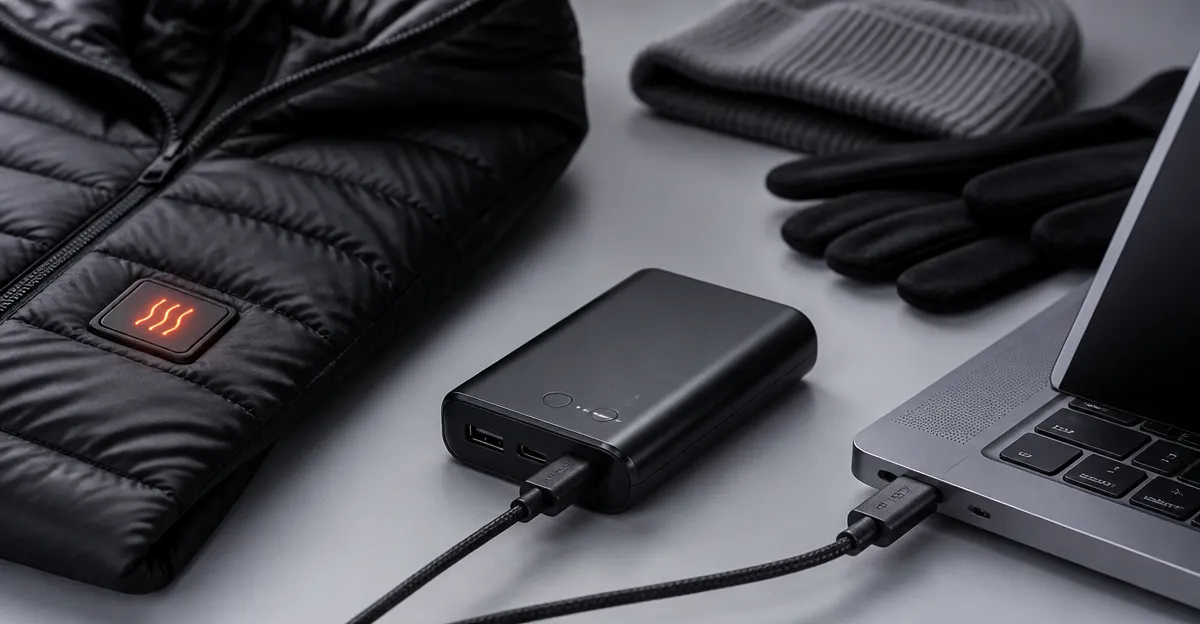
USB-C PD Compatibility Guide for Heated Clothing Battery Packs: How to Choose, Charge & Maximize Performance
Introduction
The market for portable heated apparel has expanded rapidly, and consumers now expect reliable power sources that match the demands of modern USB‑C Power Delivery (PD) standards. This guide explains the essential concepts behind USB‑C PD compatibility, outlines how to evaluate battery packs, and provides actionable advice for extending runtime while maintaining safety. Readers will learn how to match voltage requirements, interpret capacity ratings, and integrate power banks into outdoor activities. The information presented is based solely on the specifications and user feedback of the products listed below.
Background and Context
Heated clothing typically operates at either 5V USB input or higher voltages such as 7.4V, depending on the manufacturer’s design. USB‑C PD technology can deliver a range of voltages (5V, 9V, 12V, 15V, 20V) and higher currents, enabling faster charging and more efficient power transfer. Understanding the relationship between voltage, current, and battery capacity is crucial for selecting a power bank that will not damage the heating elements. In addition, safety features such as over‑charge protection, temperature regulation, and short‑circuit safeguards are mandatory for prolonged outdoor use.
Understanding USB‑C PD and Heated Clothing
USB‑C PD is a communication protocol that negotiates the optimal voltage and current between a charger and a device. For heated vest batteries that require a steady 5V/2A input, a PD‑compatible charger can still supply the required power while offering faster recharge times. Conversely, 7.4V‑only garments need a dedicated DC output that matches the higher voltage, and a PD charger that can supply 7.4V is required. Selecting a power bank with the appropriate output prevents under‑powering the heating elements, which can lead to reduced warmth or premature battery drain.
When evaluating a power bank, consider the following technical criteria:
- Output voltage options (5V vs. 7.4V)
- Maximum continuous current (A)
- Battery capacity measured in milliamp‑hours (mAh)
- Presence of an LED display for real‑time monitoring
- Built‑in safety circuitry
These factors together determine how long a heated garment will stay warm and how quickly the power bank itself can be recharged. The products examined below illustrate the range of options available to consumers.
Selecting the Correct Voltage Compatibility
For users whose heated apparel operates at 5V, any power bank that provides a stable 5V/2A output will suffice. The OKZU Heated Vest Battery is expressly designed for 5V USB heated clothing and includes a customized chip that maintains continuous output. It does not support 7.4V or 12V devices, a limitation clearly stated in its specifications. In contrast, the Buvizas 7.4V Heated Vest Battery delivers a 7.4V DC output and is incompatible with 5V‑only garments.
When purchasing a power bank, verify the voltage label on the heating garment and match it to the power bank’s output. Failure to do so can result in insufficient heating or, in extreme cases, damage to the battery cells. Users who own multiple garments with differing voltage requirements may benefit from acquiring both a 5V‑compatible and a 7.4V‑compatible pack.
Evaluating Capacity and Runtime
Battery capacity directly influences how long a heated vest can maintain warmth on a single charge. The OKZU Heated Vest Battery offers 20,000mAh, providing up to 14 hours of heating at typical usage levels. The Veauney Heated Vest Battery supplies 12,000mAh, delivering up to 12 hours on low heat settings. The VINTELEIN 2‑Pack 10,000mAh Vest Battery provides two 10,000mAh units, allowing users to alternate batteries for continuous warmth.
Higher capacity does not always translate to proportionally longer heating time because internal resistance and heat‑generation efficiency vary among designs. Users should also consider the weight of the battery; the OKZU pack weighs approximately 10 oz, while the VINTELEIN units are 7.8 oz each, offering a lighter alternative for backpacking. Balancing capacity against weight and form factor is essential for optimal performance.
Integrating Power Banks with Outdoor Activities
When planning extended trips, the ability to recharge the power bank via USB‑C PD can dramatically reduce downtime. The Anker 30W Power Bank supports 30W bi‑directional charging, enabling rapid recharge of the pack itself while also delivering fast charging to smartphones and tablets. Although it is not a dedicated heated‑clothing battery, its high‑speed input (20W) and output (30W) make it a valuable companion for recharging a 5V‑only heated vest battery on the trail.
For users who rely on campsite power sources, a power bank with a USB‑C fast‑charge input (such as the OKZU model’s 6‑hour recharge time) minimizes the period spent tethered to a wall outlet. Additionally, the inclusion of LED displays on the OKZU and Veauney models provides real‑time insight into remaining charge, allowing hikers to plan battery swaps before depletion.
Comparison and Selection Guide
| Product | Capacity (mAh) | Voltage Output | Weight (oz) | Price (USD) | Rating |
|---|---|---|---|---|---|
| OKZU Heated Vest Battery | 20,000 | 5V/2A USB | 10 | 30.99 | 4.6 |
| Veauney Heated Vest Battery | 12,000 | 5V/2A USB | ~8 | 22.99 | 4.5 |
| VINTELEIN 2‑Pack Heated Vest Battery | 10,000 (each) | 5V/2A USB‑A (dual) | 7.8 each | 22.99 | 4.5 |
| Buvizas 7.4V Heated Vest Battery | 16,000 | 7.4V DC | ~9 | 27.99 | 4.5 |
| Anker 30W Power Bank | 10,000 | 5V‑20W USB‑C (input), 30W output | ~6 | 25.99 | 4.5 |
Consumers should prioritize capacity when long‑duration heating is required, but must also verify voltage compatibility. For mixed‑voltage wardrobes, a dual‑pack solution such as the VINTELEIN set offers flexibility, while the Buvizas model addresses the niche market of 7.4V garments. Price‑to‑capacity ratios are favorable across the board, with the Veauney pack delivering the lowest cost per mAh.
Best Practices & Tips
- Confirm the voltage requirement of each heated garment before purchase; mismatched voltages will result in non‑functional heating.
- Utilize the LED display on the power bank to monitor remaining charge and avoid unexpected shutdowns during cold exposure.
- When possible, recharge the power bank using a USB‑C PD wall adapter that matches the pack’s input specifications; this reduces recharge time and preserves battery health.
- Store batteries at moderate temperatures; extreme cold can temporarily reduce capacity, while excessive heat may degrade cell longevity.
- Employ the auto‑start feature found on the Veauney, VINTELEIN, and Buvizas models to eliminate the need for manual activation while wearing the vest.
- Carry a spare battery or a high‑capacity pack on multi‑day excursions to guarantee continuous warmth.
- Regularly inspect connector ports for debris or corrosion, especially after outdoor use, to maintain reliable power transfer.
Frequently Asked Questions
1. Can a 5V USB‑C power bank charge a 7.4V heated vest?
No. A 5V‑only power bank does not provide the higher voltage required by 7.4V garments, and attempting to use it may result in insufficient heating or damage to the vest’s internal circuitry.
2. How long does it take to fully recharge the OKZU 20,000mAh battery?
The manufacturer states a lightspeed recharge time of approximately six hours when using a compatible USB‑C fast wall charger.
3. Is it safe to use the power bank while it is charging?
All listed models incorporate multi‑layer protection systems, including over‑charge and temperature regulation, which allow safe simultaneous charging and discharging under normal conditions.
4. Can the Anker 30W Power Bank directly power a heated vest?
The Anker unit provides a 5V/2A USB‑C output that can power 5V‑compatible heated clothing, but its primary advantage lies in rapid recharge of other devices and bi‑directional fast charging.
5. What accessories are needed for the Buvizas 7.4V battery to work with different connectors?
The package includes two DC adapter cables (4.0mm to 3.5mm and 4.0mm to 3.8mm) that enable connection to garments using either of those standard plugs.
6. Does the VINTELEIN 2‑Pack support simultaneous charging of two devices?
Yes. Each unit features dual USB‑A ports that can charge smartphones, GPS units, or other electronics while the battery powers a heated vest.
Conclusion
Choosing the correct USB‑C PD compatible battery pack for heated clothing hinges on understanding voltage requirements, capacity needs, and safety features. The products reviewed demonstrate a spectrum of solutions, from the high‑capacity OKZU 20,000mAh pack for 5V garments to the specialized Buvizas 7.4V unit for higher‑voltage vests. By following the best‑practice recommendations and employing the comparison guide, consumers can ensure reliable warmth, efficient charging, and extended outdoor enjoyment.
Products Featured in This Guide
OKZU Heated Vest Battery
Price: $30.99 | Rating: 4.6/5 (293 reviews)
Featured for its 20,000mAh capacity, lightweight design, and dedicated 5V USB output for heated apparel.
Anker 30W Power Bank
Price: $25.99 | Rating: 4.5/5 (15,658 reviews)
Featured for its 30W bi‑directional fast charging, compact form factor, and utility as a universal charger for devices and 5V heated clothing.
Veauney Heated Vest Battery
Price: $22.99 | Rating: 4.5/5 (572 reviews)
Featured for its 12,000mAh capacity, auto‑start functionality, and broad compatibility with 5V heated garments.
VINTELEIN 2‑Pack Heated Vest Battery
Price: $22.99 | Rating: 4.5/5 (356 reviews)
Featured for providing two 10,000mAh units, dual‑device charging, and travel‑ready dimensions.
Buvizas 7.4V Heated Vest Battery
Price: $27.99 | Rating: 4.5/5 (296 reviews)
Featured for its 16,000mAh capacity, 7.4V DC output, and inclusion of adapter cables for multiple connector types.